Before the Container: How Freight Travelled in Pieces
Before the shipping container, cargo moved in separate pieces, demanding careful handling at every transfer. See how standard boxes changed port work.
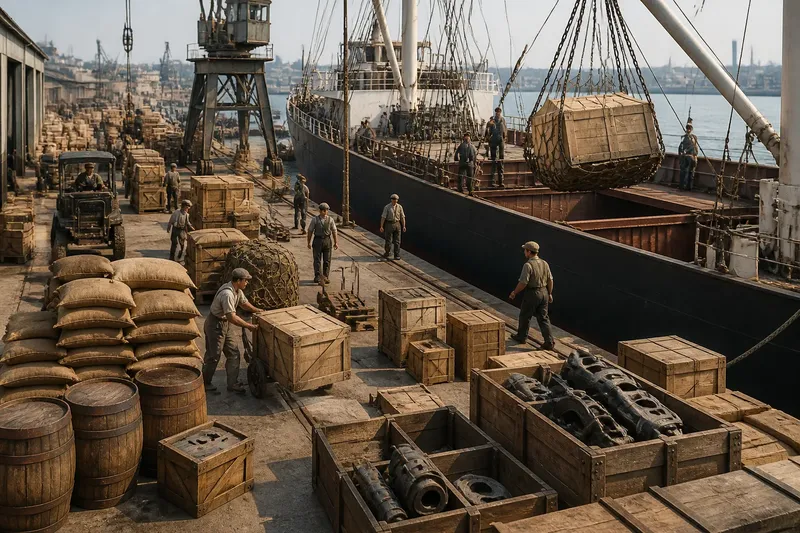
At a busy quay, a crate of machine parts might wait beside sacks of grain and barrels of oil, each destined for a different hold or customer. Before the shipping container, freight travelled in pieces: port workers handled many items separately, then sorted and shifted them again as ships and routes changed. The shipping container changed that work by letting cargo move together in a standard box.
1. Cargo arrived as a collection of separate loads
Before containers became common, goods were packed in forms suited to what they carried: bales, sacks, barrels, crates, bundles, or loose pieces. A shipment could include many packages with different shapes and handling needs. The packages might be stacked in a ship’s hold, but they did not form one reusable unit that could travel intact across the whole journey.
This is often called break-bulk freight. “Break-bulk” means cargo is handled as individual pieces or small lots rather than kept inside one large transport unit. A ship’s cargo list might group goods by destination or type, while workers still had to move each package into position.
2. Loading depended on people, tools, and careful sorting
Workers used hooks, slings, nets, hand trucks, and cranes to lift packages between a quay and a ship. The right method depended on the cargo: a fragile crate needed different care from a sack or a heavy machine component. Workers also had to stow goods so they would fit the hold and remain accessible in the right order.
Sorting was part of the physical work, not just paperwork. Packages for one port could be placed behind cargo meant for an earlier stop only if the ship’s loading plan allowed for unloading without disturbing other goods. A mistake in the arrangement could mean extra handling later, even if every item had arrived safely at the quay.
3. Each transfer created another handling point
A long journey could involve a ship, a dockside storehouse, a rail yard, and a truck. At a transfer, workers might unload separate packages, identify which onward route each belonged to, and load them again. Cargo could also wait while paperwork or a connection was arranged.
Every move required coordination among shippers, carriers, dock workers, and receivers. The more distinct packages in a shipment, the more opportunities there were for a label to be overlooked, a package to be misplaced, or goods to be exposed while waiting. These were practical risks of a system built around repeated handling, not proof that every shipment suffered a problem.
4. Standard containers made a cargo unit travel intact
A shipping container is a sturdy, standardized box designed to be moved between transport modes. Instead of unloading its contents at every transfer, workers can move the loaded container from ship to railcar or truck chassis. The cargo inside can remain packed as one unit through those changes of vehicle.
That shift is known as intermodal transport: goods travel by different modes while the same loading unit continues along the route. Standard dimensions let ports, rail yards, ships, and trucks use compatible equipment. Cranes and other lifting gear can handle the container as a whole, replacing much of the work of lifting individual packages one by one.
5. The container changed where the work happened
Containers did not make cargo handling disappear; they reorganized it. Packing and unpacking still take place, but much of that work can happen away from the ship, at a warehouse or loading facility. At the port, the main task becomes moving a sealed unit between transport modes and keeping track of its destination.
This changed the demands on ports. Container terminals need space to stack boxes, equipment suited to their dimensions, and systems for identifying which unit belongs on which ship or truck. Older docks designed for loose packages could not simply treat containers as oversized crates; the whole layout and sequence of work had to adapt.
6. A simple shipment shows the contrast
Imagine a fictional workshop sending a mixed order of spare parts overseas. In a break-bulk arrangement, the parts might travel in several labeled crates. At the port, workers would move the crates individually, and at a transfer point they could be unloaded, sorted, and loaded again onto the next vehicle.
In a container arrangement, the workshop or a nearby facility could pack those crates into one container. The container would then be moved as a unit across compatible parts of the journey, with the individual crates handled when the box is packed and when it reaches its destination. The observable difference is the number of times workers need to handle the shipment’s separate pieces along the route.
7. What changed with container shipping?
Did containers replace every kind of freight?
No. Oversized machinery, bulk materials such as grain, and liquids may use specialized ships or handling systems rather than standard containers. Containers are useful for many packaged goods, but cargo shape and requirements still matter.
Why did standard dimensions matter?
Common dimensions allow lifting equipment and transport vehicles to handle containers in compatible ways. A box that fits the equipment can move between modes without its contents being unpacked at each change.
What does break-bulk mean?
Break-bulk describes cargo moved as separate packages or pieces instead of one large standardized unit. It helps explain why older port work involved repeated lifting, sorting, and stowing.
Did containers eliminate port labor?
No; they shifted the kinds and locations of work. Ports still need people to operate equipment, coordinate movements, inspect cargo, and manage the flow of containers, while packing work may take place elsewhere.
8. The useful comparison is about continuity
The central difference is not simply old ships versus new ships. It is whether cargo remains together as a transport unit while the vehicle changes. Before the shipping container, separate packages often had to be sorted and moved at each link; container shipping made it possible for a standard box to cross those links intact.
That distinction helps explain why a container terminal looks different from an older cargo quay. The visible boxes are only part of the change: the deeper shift is a new way to coordinate handling, equipment, and transfers. When tracing a product’s route, notice whether the cargo itself is repeatedly unpacked or whether a single loading unit carries it onward.