The Long Route Inside a Cotton Shirt
The long route inside a cotton shirt separates cotton’s journey from the finished garment’s, helping you read labels and trade claims more clearly.
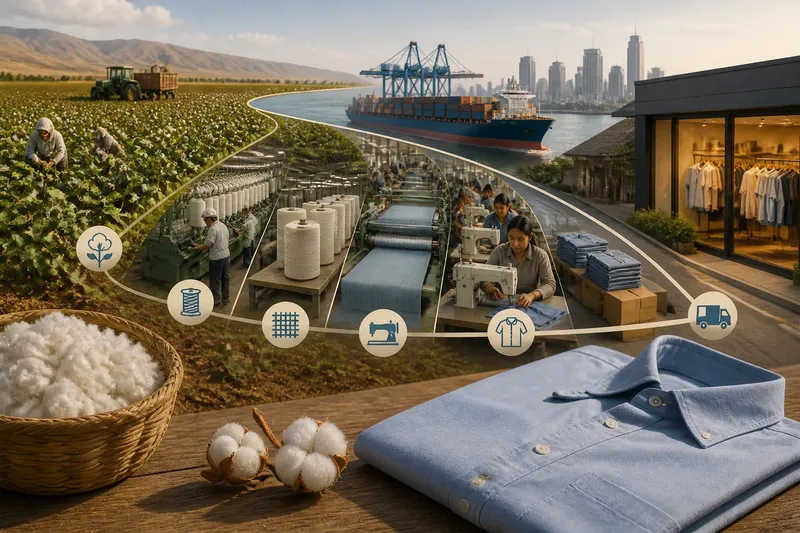
You turn a cotton shirt inside out to check its care label, but the label names only a fiber and a country of origin. The long route inside a cotton shirt can involve cotton growing in one place, yarn and fabric production in others, and sewing and retail somewhere else. To understand what a label can tell you, follow the material and the finished item as two related but distinct routes.
Separate the cotton route from the shirt route
The material route follows cotton as it changes form. Cotton is harvested, cleaned to remove seeds and other plant matter, and prepared as fiber. Spinning turns that fiber into yarn. Knitting or weaving then makes yarn into fabric, which may be dyed or finished before it is cut.
The finished-item route begins to take shape when fabric is cut into garment pieces and sewn together. A shirt may also need buttons, thread, labels, and packaging. Those components can come from different suppliers. The assembled garment then moves through distribution and retail to the person who buys it.
These routes overlap, but they answer different questions. “Where did the cotton grow?” asks about an agricultural input. “Where was the shirt made?” usually points to garment assembly, though the precise meaning depends on the label and the rules that apply where it is sold. Neither answer alone describes every stage.
Choose the route that matches your question
Use the route that fits the decision you are trying to make. A shopper checking a label, a student tracing trade, and a buyer comparing suppliers need related information, but not the same level of detail.
- If you want to know where the fiber began, look for information about cotton origin or agricultural sourcing. A garment’s assembly country does not identify where its cotton was grown.
- If you want to know where the garment was assembled, check the country-of-origin label and the seller’s product details. Treat that as an answer about the finished item’s production, not as a complete map of its inputs.
- If you are tracing trade connections, follow the changes in form: cotton fiber to yarn, yarn to fabric, fabric to garment. Each handoff can connect a different group of producers and a different place.
- If you are comparing environmental claims, first identify which stage the claim covers. A claim about cotton cultivation does not, by itself, describe dyeing, sewing, transport, or packaging.
- If you are evaluating a supplier, ask which stages its records cover and whether the information concerns the material, the factory, or the completed garment. A specific, bounded answer is easier to interpret than a broad claim about the whole supply chain.
For example, imagine a shopper finds that a shirt was assembled in one country, while a product page says its cotton came from another. The shopper can record those as two separate points on the route rather than treating them as conflicting answers. The observable result is a more accurate account: the cotton’s stated origin and the garment’s stated assembly place each describe a different stage.
Follow the transformations that create trade links
Trade in a shirt is not just the movement of a finished parcel from factory to store. Raw cotton, yarn, and fabric are distinct goods, and each can be bought, sold, processed, or transported before a garment exists. A spinning mill may purchase fiber; a fabric maker may buy yarn; a garment factory may source fabric and trim. The companies involved need not own every stage themselves.
That sequence explains why a shirt can have several production locations without any one label listing them all. The cotton’s origin concerns the crop. The fabric’s location concerns textile processing. The assembly location concerns the joining of garment pieces. Retail describes a later point in the item’s route, not where its materials began.
Keep the material route distinct from the transport route, too. A cotton shirt may involve many transfers of ownership or processing, but the available information may not show the exact path taken by each bale, roll of fabric, or finished shirt. A supply-chain map is often a record of stages and places, not a continuous travel diary for one identifiable item.
Read claims by asking what they cover
Trade language can sound more complete than the underlying information. “Made in” may refer to a legally defined point of manufacture, while “cotton from” concerns a material source. “Traceable” may mean a company can connect a product to certain suppliers or records; it does not automatically mean that every stage and input is documented.
When a claim matters to your decision, look for its boundaries. Does it identify cotton origin, a named mill, the garment factory, or only the brand’s supplier? Does it cover the shirt’s main fabric but leave out sewing thread, buttons, or other components? The answer helps you judge what the claim supports without assuming it covers the whole route.
Labels and product pages can also use different levels of detail. A country name is a useful clue, but it may not distinguish growing from processing or assembly. If a particular label term has legal significance, its meaning depends on the applicable rules; consult the relevant label guidance or a qualified professional when a compliance decision depends on it.
Which route should you trace first?
Does “made in” tell me where the cotton grew?
Not necessarily. It commonly identifies a point connected to the finished garment’s manufacture, while cotton growing is an earlier agricultural stage. Look for a separate statement about fiber origin if that is the question you need answered.
Why can a cotton shirt involve several countries?
Cotton cultivation, spinning, fabric production, dyeing, sewing, and retail can take place in different locations. Each stage changes, processes, or distributes a material or product, creating links between producers and buyers across borders.
What is the difference between tracing fabric and tracing a shirt?
Tracing fabric follows inputs and processing up to the textile, such as fiber becoming yarn and then cloth. Tracing a shirt follows the garment’s assembly and later handling, while a full account connects both routes and identifies which details are documented.
What information should I seek if a brand makes a sourcing claim?
Ask which stage the claim names, what product or material it covers, and whether the company identifies the relevant supplier or record. Those details clarify the claim’s scope without treating one disclosed stage as proof of a complete supply-chain history.
Use a map that matches the decision
For an everyday purchase, a label may be enough to learn where the shirt was assembled, while a product page may provide additional material sourcing details. For a class project or a trade discussion, draw separate lines for cotton, yarn, fabric, assembly, and retail. Mark unknown stages as unknown rather than filling them in from the garment’s final label.
The long route inside a cotton shirt becomes clearer when each answer is tied to a stage. Follow cotton when the question concerns agricultural origin; follow fabric when it concerns textile processing; follow the finished item when it concerns assembly and sale. That simple distinction makes trade connections easier to describe and keeps a useful label from being asked to tell a story it was never designed to contain.